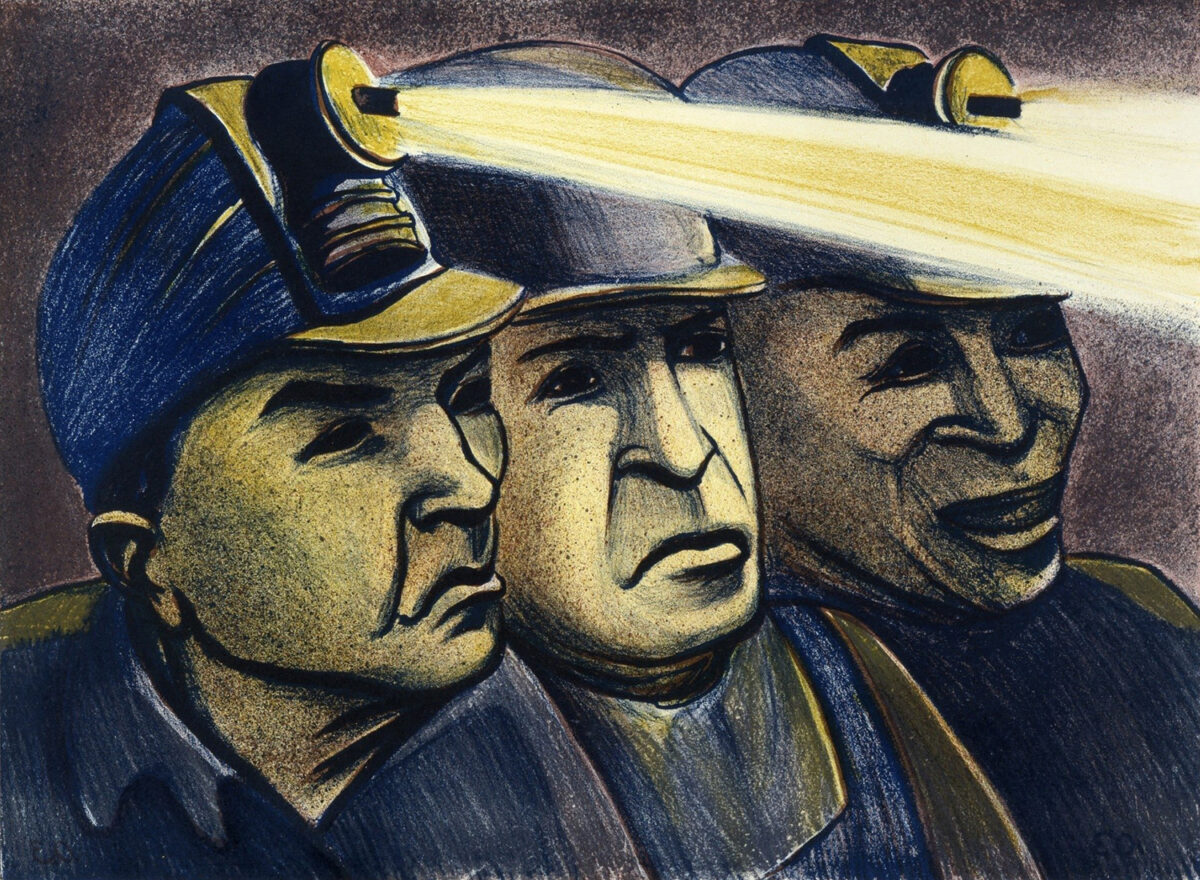
The Democratic Socialists of America is entering a pivotal moment. We stand at the forefront of left-wing politics as the largest socialist organization in the country, but the organization is not represented in the areas that need it most. The organizing priorities of DSA are heavily weighted towards more “liberal” areas, typically cities and metropolises such as Los Angeles and New York City. This is not surprising as these areas have been the primary target for modern socialist struggle in the west. As they encompass the majority of the country’s population and are culturally more left-leaning, urban areas are much easier to organize in the contemporary period than the Great Plains, the Rural Midwest, and the foothills of Appalachia. DSA must commit to organizing in these oft-overlooked places, and to kick-starting a socialist revival in the hinterlands. If the DSA is to become a mass socialist party, we must advocate for all areas and the struggle within their own conditions. We have an opportunity to do so at the 2025 National Convention.1
Conditions in Rural Areas
I live in Idaho, one of the most reliably conservative states in the nation. Here, the Democratic Party has an extremely negative image. It is dispassionate and disconnected, conceding battles to Republicans before they have even begun. Election prediction websites and results graphics don’t bother to wait for a potential upset; as soon as our polls close, we hear the familiar phrase: “We are projecting Idaho will go to the Republican nominee.”
To demonstrate just how far-right Idahoan politics is, allow me to introduce the Magic Valley Liberty Alliance, a far-right coalition mostly focused on replacing “RINOs” in the Idaho Legislature, who also happen to represent my chapter’s boundaries. They oppose DEI, mask and vaccine mandates, healthcare access for non-citizens, “chemtrails,”2 gay marriage, and any other “social justice” issue. Their Telegram channel regularly posts either blatantly or covertly antisemitic messaging which aligns with the QAnon and Sovereign Citizen movements. All of the Magic Valley Liberty Alliance legislators are backed by the Idaho Freedom Foundation, a conservative think tank that hired Dave Reilly (a neo-Nazi that was involved in planning and promoting Unite the Right)3 to shape their messaging.
The Idaho Democratic Party has all but given up running in races that aren’t their strongholds. The actual strategy passed down by the Democratic Central Committee is to register as a Republican and vote for the “moderates” in the: Republican primary. This asinine strategy capitulates power to the Republicans and constructs a mythical figure of a “moderate Republican.” Even after hosting the “Fighting Oligarchy” tour in Boise, which marked the largest political rally in Idaho history, Idaho Democrats continue to be paralyzed with indecision. They have made no moves to the left and instead continue their overtures to the fascist right. Idaho’s most prominent Democrat, Monica Church, granddaughter of former Democratic Senator Frank Church, is even working with the neo-Nazi-loving Idaho Freedom Foundation to shape a far-right school curriculum about “Western Civilization.”4
These political realities are not unique to Idaho. Fascist militias are openly organizing across the country, gaining more recruits by the day. In many states, the Democrats have either given up entirely or refused to break out from their liberal strongholds in urban areas. The same thing is happening with DSA; any attempt at a rural front in the class struggle has been abandoned. However, these are favorable circumstances for socialist organizing — in places the Democrats have abandoned and the right has torn apart, socialists can shine.
The absolute worst conditions for the American proletariat exist in the countryside. Abortion is banned, queer folks are openly discriminated against, wages are low, unions are disempowered, and ICE roams the streets with impunity. Rural communities lack equal access to healthcare, with treatment being extremely expensive and further away compared to our urban counterparts. Drug overdoses, suicides, and early death are higher in rural areas than urban areas. Healthcare institutions like hospitals, doctors’ offices, and pharmacies are closing at a rapid pace, leaving more and more people without a primary care provider or access to specialized treatment.5 Wages in rural areas are on average 24% lower than in urban areas.6 Coupled with inflation having a larger impact due to different purchasing habits, this overall inequity has resulted in rural areas becoming increasingly harder to live and work in. Due to these factors, the rise in housing costs also disproportionately affects rural communities. All of these problems are set to get significantly worse with the passage of the “One Big Beautiful Bill.”
Another massive hurdle to organizing in rural communities is the reliance that people place on religion, particularly Christianity. In my chapter’s experience, religious leaders have been both our greatest friends and our most fierce enemies. We believe it is important to use religion where we can to agitate for a Christian Socialism rather than leave Christian nationalists to organize unopposed.
Located in rural areas are also our country’s many Native American reservations. Living conditions in these reservations have been compared to the Third World.7 Unemployment rates for reservation residents have gone as high as 63%, resulting in over 90,000 Native families living unhoused or underhoused.8 In such vulnerability, crime grows rampant. These communities face countless cases of missing and murdered women that often go unreported in the media. These violent and abusive actions are rarely ever addressed or investigated due to jurisdiction disputes between tribal courts and the US Government.
Native Hawaiians face particular challenges, with their land being one of the most prolific tourist destinations in the country. Hawaii might not be a state that springs to mind when you hear the word “rural,” but in fact 95.3% of the land in Hawaii is considered rural due to low population density.9 Because of Hawaii’s high reliance on the tourism industry, the cost of living has risen significantly, causing many residents of Hawaii (including the majority of Native Hawaiians) to leave for the contiguous 48 states. The dichotomy between capitalist profits and environmental health is most visible in Hawaii, where, for example, tourism is a major polluter and threatens local ecology. In 2023, when devastating wildfires swept through Maui, Governor Josh Green was more focused on getting tourism up and running again than letting his constituents recover, bury their loved ones, and search for people that had gone missing. This ought to be a core organizing point for chapters in rural areas affected by neocolonial tourism, where the rising cost of living is being driven by metropolitan exiles migrating to live out their cowboy fantasies.
Much has been said about DSA’s predominantly white membership and how best to go about broadening its appeal and outreach to communities of color. Rural areas are left absent from this discourse. The common perception among liberals and, unfortunately, many DSA members, is that rural areas (particularly in the south and Appalachia) are full of racist whites that are beyond saving and that we must pay them no mind. This line of thinking is harmful. That is not to say there is not a significant population of racists and reactionaries living in the countryside; there absolutely is, and it is incorrect and equally reductive to deny this. But treating all red states and rural folks as a monolith does not help to grow our movement. Continuing with this liberal way of thinking will only create more resentment from people that already feel left behind. We must fight against racism and the ever-growing appeal of fascism in America, but we must not treat people as a binary between irredeemable reactionaries or the “vanguard of the real movement.” Rural workers are still people with complex opinions and, above all, class interests. Oftentimes these populations devolve into reactionary conservatism because they feel they have no other options — this should instead be conceived as a direct failure of our movement. As socialists, we must show them another path.
Ignoring rural areas not only destroys the solidarity between rural and urban workers, but also abandons marginalized communities to the whims of the most reactionary administrations. Black Americans make up a significant portion of the American South and Midwest, and are constantly under threat by police violence and fascist gangs. Arab and Muslim Americans are in significant danger due to the Trump Administration’s escalated hostility towards the Palestine movement. In many rural areas, Hispanic immigrants (many of them non-citizens) make up a large portion of our population and workforce. The Idaho Dairymen’s Association has stated that 90% of Idaho dairy workers are foreign born.10 Our communities are dependent on their labor, but they frequently work in poor conditions with no way to safely bargain with their employer. ICE raids are frequent and face little to no resistance due to a lack of abolitionist infrastructure and the physical isolation of many communities. Many of these workers do not speak English very fluently, if they do at all. DSA’s messaging must reach these most marginalized communities.
Within this increasingly harsh reality, the people want change. Opinion polls conducted by the Rural Democracy Initiative indicate that rural voters are in alignment with DSA principles.11 Some examples:
- 57% of rural voters agree: “We should grow our economy by getting more money in the pockets of working people, not corporations.”
- 77% of rural voters support legal abortion, while only 23% support bans.
- 87% support expanding broadband internet access to all communities in the United States.
- 87% believe in protecting our air, water, and natural resources from corporate and agricultural polluters and runoff.
- 92% agree that we should shift government support from corporate agribusiness to small and independent family farms.
- 62% agree that our government should invest more in clean energy, like wind and solar, to lower costs, support American energy independence, and create quality jobs that can’t be outsourced.
- 96% say that rising housing costs are a problem, with 68% saying that they’re a major problem.
This is strong evidence that rural areas would find a willing audience for DSA’s messaging and politics. It is a matter of developing a strategy that works for rural chapters in order to bring that message to the masses in an effective way. These issues are ever-present in rural communities. DSA must meet the moment, which means the organization needs to throw off its urban chauvinism and learn from historical left-wing movements that held strong in rural areas.
History of Socialism in the Countryside
In America, some of the most famous examples of socialist resistance to capitalist tyranny grow from rural organizing, typically centered around labor disputes. The Battle of Blair Mountain in the coal mines of West Virginia was the largest labor uprising in US history and the most significant insurrection since the Civil War. The Coeur d’Alene labor uprising in 1899 began Bill Haywood’s Organizing Career.12 The Colorado Labor Wars helped launch the IWW into one of the most consequential labor unions in history. This history exemplifies the need for a militancy that DSA has yet to meet in the rural parts of the country — militancy doesn’t necessarily mean confronting the state on a battlefield, but executing an organizing strategy that unapologetically flies in the face of both liberal and reactionary opposition.
Beyond militant labor struggles, socialism and left-populism also once held a strong presence in the electoral arenas of the countryside. The People’s Party (also known as the Populist Party) enjoyed support largely among farmers. In the 1892 presidential election, the People’s Party carried four Western states (Nevada, Idaho, Colorado, and Kansas), garnered 8.2% of the popular vote, and achieved the most successful third-party bid since the Civil War. In Texas, The People’s Party was formed through a rural-urban alliance between the Knights of Labor and the Farmer’s Alliance. The Farmer-Labor Party elected state governors and federal representatives to the US House and Senate, not to mention countless state legislatures. The Socialist Party of America also enjoyed continued growth and success in elections, electing politicians around the country. Notably, the SPA’s party platform included sections about the conditions of the rural proletariat, which have not yet been remedied:
- The farmers in every state are plundered by the increasing prices exacted for tools and machinery and by extortionate rent, freight rates and storage charges… Measures designed to secure to the wage earners of this nation as humane and just treatment as is already enjoyed by the wage earners of all other civilized nations have been smothered in committee without debate, and laws ostensibly designed to bring relief to the farmers and general consumers are juggled and transformed into instruments for the exaction of further tribute.13
Measures that the SPA proposed to remedy the conditions in the countryside:
- The collective ownership and democratic management of railroads, wire and wireless telegraphs and telephones, express services, steamboat lines and all other social means of transportation and communication and of all large-scale industries.
- The immediate acquirement by the municipalities, the states or the federal government of all grain elevators, stock yards, storage warehouses, and other distributing agencies, in order to reduce the present extortionate cost of living.
- The extension of the public domain to include mines, quarries, oil wells, forests and water power.
- The further conservation and development of natural resources for the use and benefit of all the people . . .
- The collective ownership of land wherever practicable, and in cases where such ownership is impracticable, the appropriation by taxation of the annual rental value of all land held for speculation or exploitation.
- The collective ownership and democratic management of the banking and currency system.
More recent examples of socialist organizing in rural areas include the Communist Party’s presence in the South during the Great Depression and Civil Rights Movement, which provided the left a much needed foothold on the front lines of the struggle for liberation and paved the way for communities of color to adapt Marxism to their own conditions. The New Afrikan Independence Movement (NAIM) in the Southern Black Belt, a rural contemporary to the Black Panther Party’s urban strategy, sought to liberate the rural domestic colonies of Mississippi, Louisiana, Alabama, Georgia, and South Carolina. These states are considered “internal colonies” due to the exploitation of labor from Black Southerners coupled with the disenfranchisement and state repression brought upon them by the carceral state. These conditions have not been remedied over time, but have instead evolved and worsened. The most recent iteration of colonial repression aimed at communities of color includes the construction of Cop Cities, which aim to train police officers in urban warfare and counter-insurgency tactics in order to put down any resistance from the people. To address this problem, the NAIM utilized a strategy of electoral struggle at the municipal level with an emphasis on rural autonomy and breaking the rural/urban divide by creating an economy based on self sufficiency — through a publicly owned bank for farmers, co-op style farming communities, and a cultural revolution that directly confronted the dominant social conservatism (based in and perpetuating colonial values).
Even more can be drawn from the Bernie Sanders presidential campaign. In 2016, Bernie won the primaries for rural states like Kansas, Wyoming, Montana, Idaho, North Dakota, Oklahoma, West Virginia, Indiana, and Alaska. Idaho and Alaska respectively were in the top 5 states with the largest margins of victory for Sanders. Notably, the margins of victory in Iowa, Missouri, and Kentucky were all under 1%, which still indicates a high level of support for socialist-adjacent ideas.
More Perfect Union, an independent journalism nonprofit, produced a 2024 documentary where they visited Elliott County, Kentucky.14 Elliot County was a historically reliable voting base for Democrats for more than 140 years, and then underwent the largest shift to Trump in the entire country. Curiously, they voted Democrat Andy Beshear for Governor in 2019 and 2023. Residents of the county expressed frustration with their living conditions and the death of union jobs. Democrats were seen as the party of blue collar workers, until they weren’t. Andy Beshear was elected because he was seen as an authentic supporter of unions and an effective politician for rural communities. Elliott County also voted for Bernie Sanders in the 2016 Democratic Primaries.
We also cannot forget the struggles of the international communist movements that took place largely among rural peasants. Cuba, China, Vietnam, Nicaragua, the Zapatistas in Mexico, India, the Philippines, and many more had large or majority rural bases of support. Left-wing parties and organizations have done effective organizing in the countryside throughout history. The conditions facing rural populations have hardly changed since the heyday of these struggles, and in some cases have even gotten worse. DSA cannot continue ignoring these areas. We have made serious progress, with multiple congressional seats; the passage of numerous LGBTQ+, Sanctuary City, and BDS resolutions across the country; winning a retreat of Avelo’s cooperation with ICE on the West Coast; and now the mayor of the largest city in the country (assuming Zohran wins the general election in November). Like those that came before us, we are capable of bringing socialism to the rural communities of this country left behind by capitalism.
How DSA Can Compete
Above all, the reason DSA has not made inroads to rural communities is because the organization as a whole does not know how to relate to them. The mantra of “it is easier to radicalize a liberal wine mom than a coal miner in Kentucky”15 rings throughout the leadership and membership of DSA. The wine mom and the coal miner each have political grievances that we can speak to. The wine mom is disgusted by Trump’s attitude towards women; the coal miner wonders if a union would make his workplace safer. Both are exploited, and both can be made into socialists. This attitude of placing the wine mom over the coal miner reveals that many in DSA can see themselves in the wine mom but can’t relate to the coal miner. This also reveals a glaring problem among the class character of DSA’s membership, where a large portion is made up of the white collar class (wine mom) rather than blue collar laborer (coal miner). In order to appeal to both of these people DSA must expand its capacity to respond to more than just social issues (something we are extremely good at), and utilize economic messaging that can appeal to the grievances of the wine mom AND the coal miner.
In rural areas, agricultural issues are large parts of the political leverage, yet the DSA never mentions its policies aimed at farming communities, therefore failing to appeal to those working the farms. For example, DSA has a policy aimed at providing small farmers access to affordable credit and fighting against the concentration of corporate agriculture. In communities where small farmers are being bought out by large corporations, such a policy would demonstrate that socialists have farmers’ backs. Socialists can act as a large, vocal, and organized force for these rural communities, yet this kind of positive resistance does not exist.
Leading up to the 2025 DSA Convention, caucuses like Groundwork and Socialist Majority scream to the heavens about how the convention delegates must deliver them an NPC majority so they can “Export Zohran.” We know they aren’t talking about rural America. We know this because these caucuses have focused solely on the electoral arenas of large urban cities. The favorable conditions that contributed to Zohran’s win do not exist out here. We do not possess robust public transportation; our roads are made of dirt and gravel. We do not benefit from concentrated population density; some of our houses are miles away from our neighbors. We do not use Ranked Choice Voting or matching public funds; these processes have been completely outlawed by our state governments.
Building a movement cannot be done by using cookie cutter politicians and election strategies. It cannot be “exported” from the cities to the countryside. Like the crops that grow in our fields, our movement must be carefully cultivated and grown from the ground up using the knowledge that we have about our own conditions. And right now, DSA has an opportunity to start planting those seeds for long-term rural organizing.
First, we can use convention to kickstart strong rural organizing while removing some of the roadblocks that have been placed by urban-supremacists:
- Pass R15-Take the Fight to the Rural Front: This resolution establishes a Rural Organizing Working Group (ROWG), made up of rural organizers. The working group will develop DSA’s strategies for rural outreach, jumpstart organizing committees in strategic rural cities/counties, and create materials for rural chapters to use in their communities. The ROWG will also formulate DSA’s agriculture platform, which will allow the national organization to have a much more robust set of policies that speak to people around the country. In an era of increasing polarization and accelerating capitalist decay, DSA has to formulate strategies to reach rural America rather than leaving them to the whims of the fascist right. This cannot be done using strategies formulated by and for urban areas. We must let the rural organizers determine their own strategy and in turn create resources to continuously improve the image of socialism and DSA in the countryside.
- Pass R32- Towards a Multilingual DSA/Hacia un DSA Multilingüe: This resolution places a heavier emphasis on multilingual organizing, beginning with Spanish, and further commits DSA to integrating with non-English speaking immigrant communities. In areas with large immigrant and refugee populations, language is a major barrier to organizing. Having a robust language exchange program will not only allow organizers to better integrate with immigrants, it will also provide an entry point into DSA for workers who might otherwise have limited solidarity networks or support bases.
- Pass R43- Locals-First DSA: Increase Dues Income for Locals and Stabilize National Budget: This resolution will provide smaller and more rural chapters with a larger percentage of their dues, which will empower their organizing and give them more breathing room in funds. Often, smaller chapters struggle to raise funds and have to coast by with no money. Even when dues share hits, it often feels like not enough. Giving chapters a larger share of their dues will not only improve the organizing capacity of smaller chapters, it will massively increase the morale of the members that often feel their dues aren’t being put back into their local chapter.
- Pass R37- Building a United Front Toward 2028: This resolution commits DSA to building organizational and electoral coalitions with labor and likeminded socialist organizations, with the goal of forming a strong political and economic coalition for May Day 2028. With the absence of the Democratic Party in much of the country, it only makes sense for DSA chapters to forge alliances directly with labor unions and other socialist formations.
- Reject CB06- Proportional Representation for Chapters at Convention: This proposed change to DSA’s convention disempowers small and rural chapters’ already miniscule voice in the organization by handing more power to the large urban population centers like NYC and LA, and giving their delegates more voting power. This move will only further stifle our voices in this pivotal moment and further entrench the power of the urban population centers and the PMC class within DSA.
- Elect NPC candidates that are committed to supporting rural chapters and integrating locals with the NPC more broadly. My shortlist includes: Ahmed H. (Springs of Revolution), David J. (Libertarian Socialist Caucus), Cliff C. (Marxist Unity Group), Sid C.W. (Marxist Unity Group), and Sarah M. (Reform and Revolution). These NPC Candidates are the most vocal about their commitment to connecting National DSA with chapters around the country and are most focused on supporting rural and red state chapters that are in the belly of the beast. Having all of these candidates on the NPC would give me hope for a future where DSA can more effectively organize in rural areas and red states.
DSA can also take on longer term shifts towards rural organizing by:
- Utilizing the Comms Committee to elevate rural conditions and the struggles that are ongoing in rural communities. Giving a much-needed boost to the struggles going on in rural areas and the chapters that are working on them will improve morale among rural chapters and give other chapters a better sense of the sorts of things we are dealing with.
- Investing in strategies to counter the religious right. More effort should be dedicated to the theoretical study of Liberation Theology, spiritual anarchisms, and their practical applications. In rural places, where religion is ever-present and many people rely on it for community, Christian Nationalism is growing at a rapid pace. We cannot cede this ground to fascists.
Go Down To the Countryside
In an era of increasing polarization and radicalization, DSA cannot afford to ignore the countryside anymore. We must integrate into places like Idaho, Kansas, Kentucky, and West Virginia. If we are truly committed to an organization that fights for socialism for all, then we must be among all the people, whether this be in electoral contests, labor and tenant organizing, mutual aid, or political education. DSA must move against the tide of urban and rural conflict, focusing on the one common enemy: the capitalist class. The people of the plains and hills yearn for liberation. We have been abandoned by everyone; and DSA can be the one to pick us up again.
Isaac R. is a rural organizer, Co-Chair of Southern Idaho DSA, and Emerge member focusing on mutual aid and building DSA into an independent socialist party as an alternative to the Democratic Party.
1 Defining the word “rural” is often tricky, as people have different definitions of what is “really” rural. For our purposes we will define it as: any location with low population density, a low percentage of land usage (paved roads, buildings, etc.), and a population of up to 5,000 people. The Census Bureau determines that 76% of incorporated places hold populations of less than 5,000 which contrasts with only 4% of cities nationwide that hold more than 50,000 people.
2 https://politicalpotatoes.substack.com/p/chemtrail-clint-hostetler
3 Political event attended by numerous fascists, neo-Nazis, and general reactionaries. In 2017, the event ended in the death of Heather Heyer, an anti-fascist counter-protester, after she was run over by a neo-Nazi.
4 https://www.idahostatesman.com/news/politics-government/state-politics/article307080991.html
5 https://www.ruralhealthinfo.org/topics/healthcare-access
6 https://www.ers.usda.gov/data-products/charts-of-note/chart-detail?chartId=84389
7 https://www.health.harvard.edu/blog/poor-housing-harms-health-in-american-indian-and-alaska-native-communities-202204062721
8 http://secure.nativepartnership.org/site/PageServer?pagename=naa_livingconditions
9 https://files.hawaii.gov/dbedt/census/census_2020/data/reports/HI_Urban-Rural_2020.pdf
10 https://idahodairymens.org/governmental-affairs/immigration-reform
11 https://ruraldemocracyinitiative.org/wp-content/uploads/2024/05/Rural-Voter-Research-Deck-05.07.2024-Rural-Democracy-Initiative.pdf
12 https://time.com/archive/6776850/radicals-death-of-haywood/
13 http://www.laborhistorylinks.org/PDF%20Files/Socialist%20Party%20Platform%201912.pdf
14 https://youtu.be/yfxvHqTCy2w
15 https://x.com/leftistbrayden/status/1934327130524910061
Isaac R. is a rural organizer, Co-Chair of Southern Idaho DSA, and Emerge member focusing on mutual aid and building DSA into an independent socialist party as an alternative to the Democratic Party.
