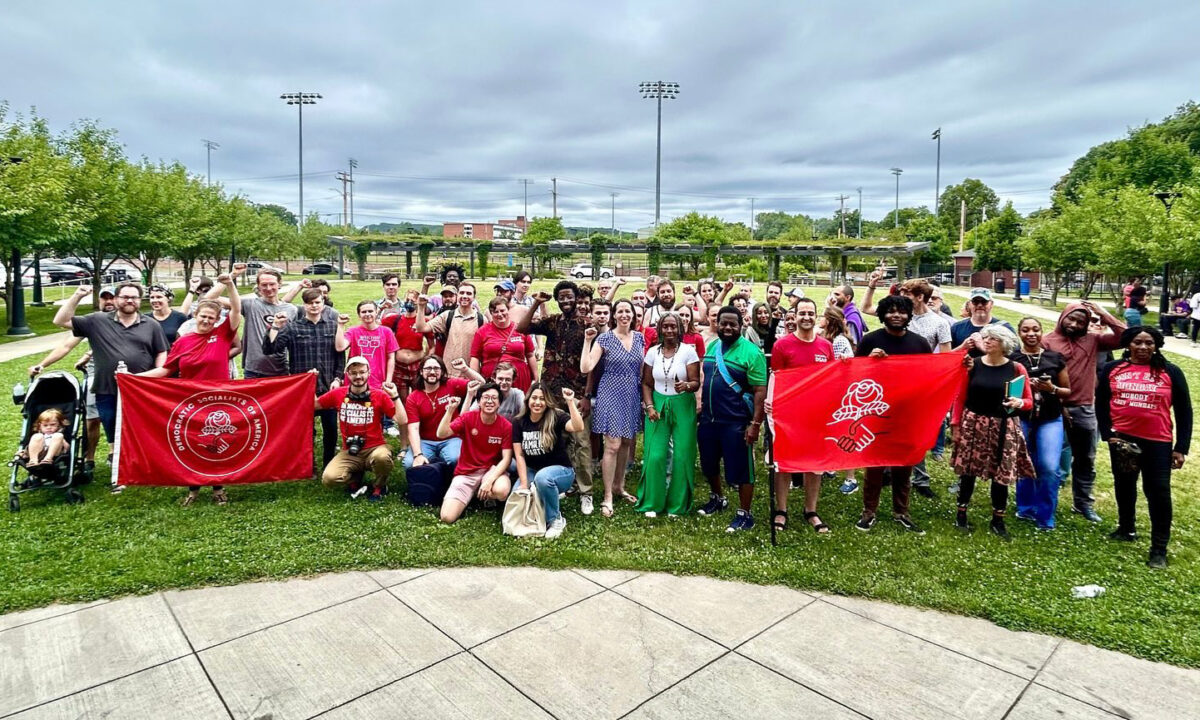
On November 2, 2021, Abdul Osmanu and Mariam Khan – both 19 – made national headlines by becoming the youngest and first Muslim electeds in history on the Hamden Legislative Council and the Hamden Board of Education, respectively. They were also part of the first socialist slate elected in the state of Connecticut in 60 years, together with Justin Farmer, who was re-elected to his third term on the Legislative Council. Central Connecticut DSA’s basked in our first experiment running a slate of candidates resulting in a victory across the board, and DSA could boast its youngest ever nationally endorsed candidates.
In the three years following that victory, the socialist voting block on the Hamden Legislative Council continued to grow and evolve. Laurie Sweet, originally elected without a DSA endorsement, joined our chapter while in office and was endorsed for her re-election campaign. Rhonda Caldwell replaced Justin Farmer after the end of his third term. Despite being a minority on the council, this 3-member bloc proved to be mighty, passing the strongest tenant union protections in the state. In 2024, both Abdul and Laurie decided to enter the race for seats in the state house – this time, however, without seeking national endorsement.
If a candidate wants to be endorsed by the Democratic Socialists of America, they have a long to-do list. First, they must receive their chapter’s endorsement. There is no standardized process for how this plays out; in some chapters, extensive questionnaires and membership votes take place. In others, leadership interviews a candidate directly.
If a candidate receives their chapter’s endorsement, they must ask their chapter to submit an application to DSA’s National Electoral Commission to be considered for a national endorsement. The NEC asks the chapter to fill out a national questionnaire detailing the candidate’s stances and alignment with DSA’s platform. In addition, the chapter is asked to submit a campaign dossier, offering logistical and administrative information about the race, including field and fundraising data. The NEC also meets with the chapter to ask any clarifying questions before conducting a vote of its Steering Committee. Candidates that are approved by the NEC’s Steering Committee are then deferred to the National Political Committee for a final vote that determines whether or not they receive a national endorsement.
In 2021, Central CT was in the process of rebuilding after finding itself in troubled waters at the beginning of the COVID-19 pandemic. A few flagship campaigns like our Right to Council legislative campaign and the election of the Hamden ‘JAM’ slate were central projects that kept the chapter together and anchored our organizing. Our leadership was able to prioritize getting national endorsement as a way of generating excitement from members. By 2024, however, Connecticut DSA – renamed after a merger between the Central CT, Western CT, and Quiet Corner chapters – had grown significantly, with six branches across the now-statewide chapter, seven issue-based working groups, involvement in various statewide coalitions, and deep participation in the mass movement against the genocide in Gaza.
In consultation with Laurie and Abdul, the chapter submitted initial materials to open the consideration process for national endorsement with the NEC. However, with the process drawn out over weeks, scheduling an interview with a member of the NEC Steering Committee, finally agendized mere days before the primary election, proved itself impossible, and we communicated to the NEC that we would not be moving forward with national endorsement for our campaigns.
The process to get national endorsement was deemed too onerous and the benefits too nebulous to make it worth the scarce capacity we had during hard-fought campaigns and juggling numerous parallel projects. Laurie’s victory in that race made history again as Connecticut DSA celebrated its first endorsed candidate winning a state-level election, but the national organization had no part in the campaign – nor the positive press it could have earned.
DSA’s highest profile campaign this year has undoubtedly been Zohran Mamdani’s exciting primary upset in the race for New York City mayor. Under DSA’s current two-tiered endorsement process, national endorsement applications are submitted by the relevant local chapter. NYC-DSA’s Steering Committee decided not to submit Zohran’s campaign for national endorsement consideration. But to our members, the media in its coverage of the election, and the millions in the public following the race, there is no doubt that Zohran is a DSA candidate, and that his victory represented a historic moment for the entirety of DSA’s electoral project.
Members across the country were inspired by Zohran’s bold advocacy for affordability, immigrant justice, and Palestinian liberation, and felt moved to get involved. Connecticut DSA organized a field day for our members to commute to the Bronx and knock on doors. However, Zohran’s status as a local rather than national endorsee limited the scope of this exciting solidarity work.
For example, the NEC runs frequent phonebanks and fundraising events for a slate of our national endorsees, featuring specific races at various times of the year. With Zohran’s primary coinciding with local electoral races being undertaken by smaller chapters, such as Jake Ephros’ campaign for Jersey City Council or Kelsea Bond’s campaign for Atlanta City Council, Zohran joining the NEC’s socialist slate could have brought in hundreds of thousands in member-driven fundraising, and diverted thousands to those other candidates, too.
Zohran’s inspiring win, in many ways our highest-profile victory of this decade, demonstrates the redundancy of an arbitrary and administrative distinction between our local and national elected officials. To the new members joining Connecticut DSA after Zohran’s victory, it matters little that Zohran was not nationally endorsed. An individual chapter’s victory moves the entirety of our organization forward, and conversely, any single DSA elected official, regardless of where their endorsement comes from, can cause harm that is felt deeply across chapters.
For years, DSA has struggled to straighten out points of deep friction within our big tent about how we should attempt to move elected officials like Los Angeles City Councilmember Nithya Raman to our democratically-decided positions on Palestinian liberation. Springs of Revolution is bringing forward CR05-A02 – One DSA: Towards a Unified Endorsement Process. One DSA would make all local endorsements the organizational standard, allowing class struggle campaigns like Abdul’s and Laurie’s to receive immediate access to the full power of DSA’s electoral machine, from its formidable communications reach to its grassroots fundraising operations. On the other hand, by dissolving this distinction, the NPC would, in earnest partnership with local chapters, have the responsibility to ensure that all of our elected officials are honoring our democratically decided positions and policy priorities.
By dissolving the distinction between local and national endorsements, One DSA identifies a critical organizing reality: that there is no way around making difficult, democratic decisions in our organization, and that making them will embolden rather than weaken DSA on the scale of years and decades.
Francesca Maria is running for DSA’s National Political Committee on the Springs of Revolution slate. She has been a member of Connecticut DSA since 2021, recently serving as the chapter’s co-chair. Francesca cofounded the Connecticut Palestine Solidarity Coalition and has been coordinating the national No Appetite for Apartheid campaign since its launch. In her civilian life, she shuttles between harm reduction research and food service.
