Comrade Marisa M.’s piece “The Third Precinct Still Burns: Black Freedom and Political Power,” recently published in Light and Air,1 is an important contribution to a frantic political discourse around black liberation and the 2020 uprisings developing in mostly left DSA spaces in response to NYC Mayor Zohran Mamdani’s pattern of capitulation to police power. The core theses of the piece are unassailable: that police power remains one of the bigger organized threats to the socialist movement in a way redistributionism doesn’t address, that the subjugation of black populations serves as an important anchoring point for American capital and white supremacy, which in turn is continually reorganized to maintain this oppressive racial regime, and finally that black liberation must be a core part of any liberatory political programme. Yet the piece suffers from a core limitation of the current discourse itself – the call to “rediscover” black liberation in DSA has only arisen out of perceived contradictions with the electoral project, and not DSA’s political praxis as a whole, especially as related to grassroots abolitionism.
“Political action” in Comrade Marisa M.’s view contrasts with the “abstentionism” of the left in response to the events of 2020, the ultimate aim of said political action being the need to “incorporate the demands of black liberation into our electoral platform.”2 Yet, one cannot help but wonder if this puts the cart before the horse. DSA’s overall engagement in abolitionist work, although certainly present in some chapters, is by-and-large weak and limited. This is despite police power’s reality of expanding force. Police murder has steadily increased since 2020, with police murders in the 2021-2025 period increasing 12% yearly on average compared to 2020, and police murder of black people specifically increasing 16% yearly on average compared to 2020 in the same period.3
While police murder has continued to be invisibilized by the state and civic society, including by the “serious left’s” call to take the empty, floating signifier of an amorphous “public safety” seriously, the racial disparity of youth incarceration in states like Illinois and New York has more than doubled in the past 10 years. Black youth are sentenced to incarceration at more than 5 times the rate of their white peers, with tribal and Latino youth facing disparities of around 4 times.4 5 In cities like Philadelphia, the expansion of “wellness courts” and mask bans has increased the rate of broken-windows policing6 with the goals of removing visibly racialized poverty and addiction from the streets whilst deepening the police occupation of black and latino neighborhoods.7
For black families whose children are routinely murdered by police occupation officers, snatched away for sitting on “no loitering” stoops or wearing ski-masks, or wrongfully imprisoned for decades on end, a revolving door of capitalist, progressive, liberal, conservative, and yes, socialist, politicians knocking on doors during election season or simply making impassioned speeches in legislatures and councils means very little. For DSA to be taken seriously, not just among long-time abolitionist organizers, but for these families facing the brunt of settler-colonial police power, chapters must be ready to build extra-parliamentary defense structures, work directly with families to make police murder visible, apply pressure on the prison-industrial-complex to decarcerate imprisoned masses with an inside-outside strategy, and work more diligently to build trust with oppressed communities outside of electoral campaigns.
I do not think Comrade Marisa M. or anyone else on the DSA left will find these proposals necessarily controversial. However, this also means a hard shift in DSA’s actual political praxis; electoral organizing takes up so much time and space that community defense and abolitionist world-building can easily fall to the wayside or otherwise be subordinated to the electoral project. If we agree that black liberation cannot merely be spoken, that it cannot be reduced to planks floating in a programmatic sea, that more than anything it must be practiced in a manner that expands the popular protagonism of colonized and subjugated nations and communities, we must ask if our current mode of electoral politics is conducive to that at all.
A black liberatory electoral politics, perhaps best exemplified at the moment by proposals like Zohran’s plan to abolish New York City’s Strategic Response Group (SRG) or create a Department of Community Safety, disconnected from a black liberatory praxis will bring us to the same types of concessions and withdrawals that have led to this frantic soul-searching among the DSA left in the first place. Some may say that the expansion of Abolish ICE organizing among DSA chapters indicates that this shift is possible. However, while the anti-ICE movement is one of the key sites of abolitionist struggle today, it has also been systematically disconnected from the wider abolitionist movement, in no small part due to co-optation by the progressive Democratic and NGO sphere.
Ultimately, for DSA to authentically adopt a politics of black liberation, we must ask difficult questions about allocating the time and energy of organizers, implement an internal cultural revolution against the white supremacy that frequently drives out radical black and brown organizers, and develop a strong national leadership willing to impose a political direction onto chapters.
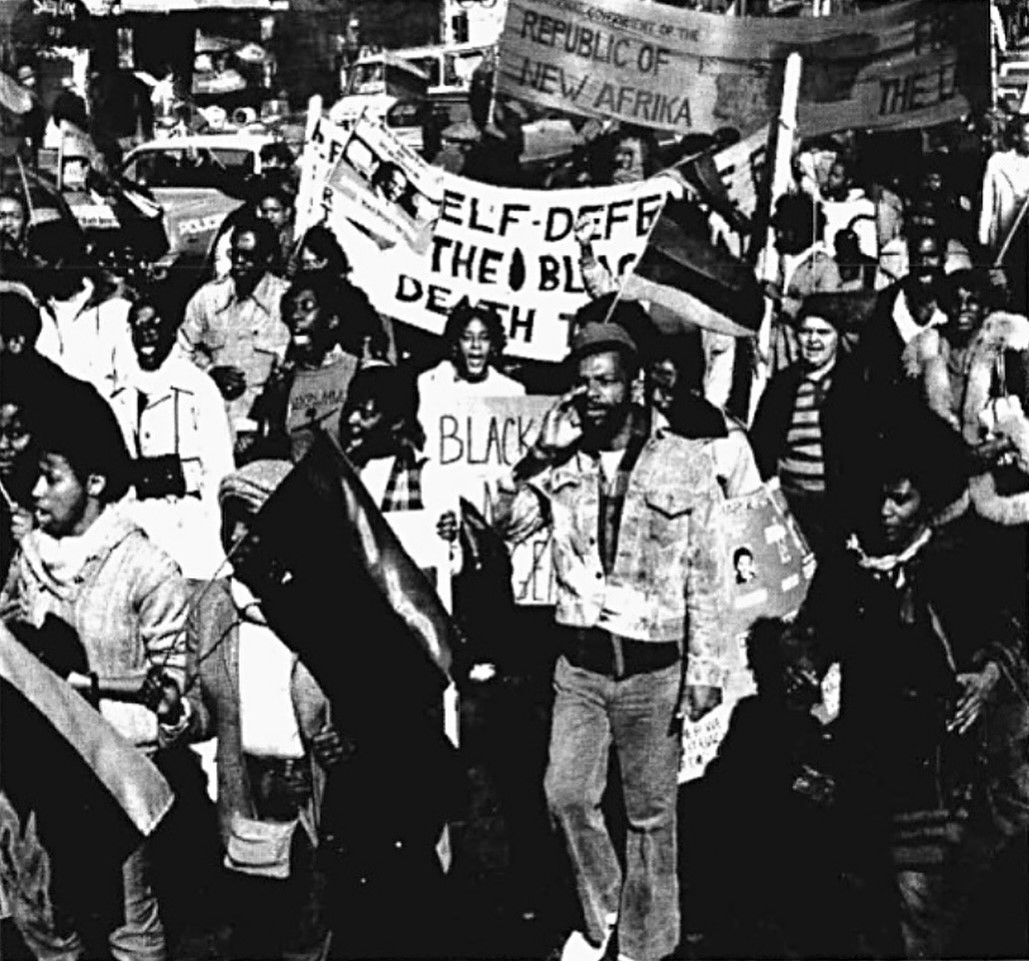
Describing the failed Revolutionary People’s Constitutional Convention (RPCC), an attempt to draft a revolutionary socialist, anti-racist, movement-based constitution in Philadelphia, organized primarily by the Philadelphia Black Panther Party (BPP) and headlined by Huey Newton himself, imprisoned revolutionary Mumia Abu-Jamal writes in We Want Freedom: A Life in the Black Panther Party:
“David Hillard and many other Party members … remember the [RPCC] as an abject failure … they also look to Huey’s poor [speaking] performance at the plenary session as a nadir of the Party’s attempt to institutionalize a truly revolutionary movement in the US”8
Contrasting this view, and worth quoting at length, he continues:
“While the Party dared greatly, it was not, in truth, a failure of the Party so much as it was a failure of the movement … were millions of white youth, no matter what they claimed their political or ideological persuasions, really ready to embark on a revolution … that did not prize whiteness? Were millions of feminists ready to join in working coalition with men and women of color, to destroy white supremacy as a binding stitch for the White Nationalist (Herrenvolk) Republic? Were millions of mostly white gays and lesbians willing to join a political entity where, though represented, they were not in the ascendancy?
It is indeed possible that the [BPP] … could not appreciate the deep levels of white supremacy that lay subsumed within much of the white left. They opposed the war in Vietnam … they opposed the excesses of the Nixon/Mitchell regime … they may have felt an ideological affinity with the Civil Rights Movement … but were they ready to do all that was necessary to break asunder from their Mother Country – White America?”9
For DSA, the question in front of us remains remarkably similar. No amount of programmatic unity around the question of secession or the title of land for black people, no amount of campaigning on abolition democracy, will matter if we do not look internally to our practice and ask if we, in our actions, in our movement, in our institutions, in our people, are really ready to tear America asunder.
- The Thid Precint Still Burns: Black Freedom and Political Power Marisa M, Light and Air, accessed June 3, 2026, https://www.marxistunity.com/light-and-air/the-third-precinct-still-burns-black-freedom-and-political-power,
- Ibid.
- “Mapping Police Violence,” by Campaign Zero, Mapping Police Violence, accessed June 3, 2026, https://mappingpoliceviolence.org/
- Breanna Bishop, “Black and Tribal Youth Bear the Brunt of Rising Incarceration Rates,” The Sentencing Project, April 7, 2025, https://www.sentencingproject.org/press-releases/black-and-tribal-youth-bear-the-brunt-of-rising-incarceration-rates/
- Rovner, Joshua. “Black Disparities in Youth Incarceration.” The Sentencing Project, May 18, 2026. https://www.sentencingproject.org/fact-sheet/black-disparities-in-youth-incarceration/
- A tactic of police-power originating from criminologist George Kelling, which argues that minor offenses should be harshly policed to maintain ‘law and order.’
- Emily Rizzo, Emily Rizzo, and Silvia Canelón, “New Kensington ‘Fast-track Court’ Lands Most With Warrants, Back Into the Cycle of Addiction and Homelessness,” Kensington Voice, March 23, 2026, https://www.kensingtonvoice.com/new-fast-track-court-for-kensington-lands-most-with-warrants-back-into-the-cycle-of-addiction-and-homelessness/
- Mumia Abu-Jamal, We Want Freedom: A Life in the Black Panther Party, Print (South End Press, 2004), 76.
- Ibid., 77.
