CERAWeek 2026
Imperialism Panel
In March, three Gulf South DSA chapters teamed up with frontline organizations and leaders from across the region to take on the largest fossil fuel villains on the planet during their meeting at CERAWeek, organized by consulting firm Cambridge Energy Research Associates. Time calls CERAWeek “the industry’s most influential annual conference.” Frustrated by a narrow focus and watered-down messaging, members of Corpus Christi DSA, Houston DSA, and Southwest Louisiana DSA set out this year not just to transform the collective response and resistance to CERAWeek but also to build our own independent messaging and programming.
Our chapters were able to center our frontline communities most impacted by environmental racism and fossil colonialism, raise awareness about the worst corporate polluters across the region and the consequences of their destruction, and amplify the demands from home. At the same time, we set out to draw more attention to our shared struggles with workers around the globe bearing the brunt of fossil imperialism.
This meant drawing key connections to CERAWeek speakers complicit in the militarization of the border and attacks on immigrants, complicit in war and genocide, and profiting off of foreign intervention. In addition to speakers like Chevron CEO Mike Wirth and anti-Maduro “Peace” Prize recipient María Corina Machado, there were several sessions on the war in Iran.
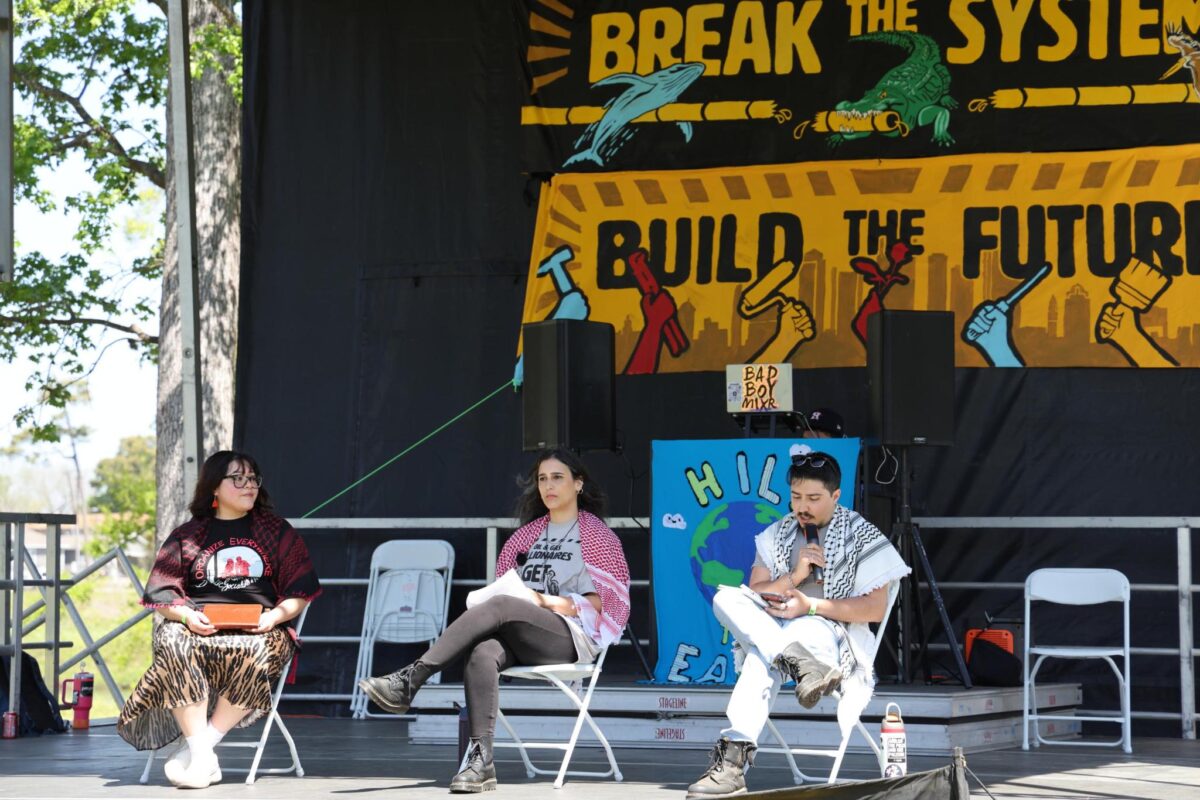
It was crucial that we take seriously our responsibility to build and enact solidarity intentionally. In addition to disrupting the conference and bird-dogging attendees, we hosted several political education sessions including a panel on fossil imperialism featuring Chloe T. from Corpus Christi DSA, Safa from Palestinian Youth Movement and Houston Arms Embargo, and Emerge member Richard H. from Houston DSA as the facilitator. The panel sets out to map a clear Gulf Southern strategy to meaningfully build solidarity from the Gulf to Gaza. The transcript has been edited for length and clarity.
Richard: I’m going to introduce Dani who is not here with us really quick. Dani Marzouca (they / them), with the US Campaign for Palestinian Rights, said that they’re “devastated to miss this opportunity to join this powerful force of nature. I send you my power and my gratitude for defending life on earth. Let’s blame US imperialism and the fossil fuel industry for why I couldn’t be here with you today. This unprecedented heatwave unearthed new, unprecedented levels of disability.”
I’m going to start us and center us by defining fossil imperialism. This is also written by Dani: “We’d like to offer this framework as the foundation of our panel. Imperialism is the stage of capitalism in which the owning class must expand outside its borders in order to control the flow of capital and resources between other territories. Imperialism is about denying the sovereignty of a people. Under capitalism, expansion is necessary. Capitalism is organized by the logic of endless accumulation: in order to make larger and larger profits, capitalists need control over territories but also control over supply chains, over financial systems, over who gets to move resources where. To maintain that control, imperialist states such as the US wage war on other nations.
“Fossil fuels are a prime example of what imperialists are willing to go to war for. This is because fossil fuels have the energy density and mobility that capitalism’s logic of endless pursuit of profit demands. In this pursuit, capitalists, like billionaires at CERAWeek, are willing to subject people and the planet to mass extinction, displacement, premature death, and organized abandonment. We reject this way of living and have strived to embody this resistance through our respective organizing and our campaign work.”
Now for a campaign overview starting with Safa from Houston for an Arms Embargo.
Safa: To give a little bit of an overview, Houston Arms Embargo is a grassroots campaign led by the Palestinian Youth Movement and Palestine Solidarity Texas to stop the Port of Houston from being used in the genocide of the Palestinian people. The Port of Houston is a very important link in the supply chain arming Israel, largely due to its proximity to the Lockheed Martin facility in Fort Worth.
This facility is the only place in the US where Israel’s crown jewel, the F-35 fighter jet, is assembled and flown directly to the Israeli military to bomb Gaza. Our research shows that the Port of Houston is regularly transporting critical parts for the F-35, without which Israel would not be able to commit its genocide. So, as Houstonians, we have an incredible opportunity and responsibility to help end the genocide.
Our goal is for the City of Houston to enact a total arms embargo on Israel through demanding that the Port of Houston halt all shipments of the cargo used in the genocide.
The Houston Arms Embargo grew out of PYM’s Mask Off Maersk campaign which identified logistics as the key artery of the genocide and Maersk specifically as the company shipping the majority of Israel’s military cargo. This foundation along with reports by PYM on the F-35 supply chain helped us uncover the flow of these components through our port, and we’ve found that Houston is not just another facet but an important point in Israel’s weapons supply chain.
This effort has since developed into a citywide Houston Arms Embargo campaign. Over the last two and a half years, we’ve really seen the birth of an international movement focused on disarming Israel and this campaign stands as one localized front in this global struggle.
Since launching the campaign we’ve built a growing coalition of over 35 organizations committed to winning an arms embargo in Houston. Every week, dozens of supporters (many of whom are here) take to the streets talking to communities from Fort Bend to La Porte and gathering thousands of signatures demanding an end to these shipments. We’ve mobilized against ongoing F-35 shipments at the port not too far from here and recently, in November, there was the Houston International Maritime Conference — a huge conference for the shipping industry — and we disrupted Maersk’s participation with a three-day picket outside where we spoke with thousands of attendees about the role of the Port and the role of Maersk in the genocide.
We’ve also been speaking with dockworkers for over a year now, the majority of whom are all horrified to learn that their workplace is complicit in the genocide. Even as union power continues to be undermined in the US, we understand labor as the decisive force in our struggle and we know that no shipment of oil, no shipment of war machinery can be possible without the workers and so our campaign is also working to build relationships with other unions throughout varying labor sectors.
We believe that an arms embargo will hopefully be won from below through mass participation. Gaza has shown us that the political class will only ever work in their own interests, ignoring the will of the people, so we need to come together to enforce that will.
It’s not surprising that people in Houston refuse to be complicit in genocide, but they also recognize that their suffering here in the US comes from the same political ruling class. This is why the campaign has been such a unifying force in the city. The same politicians who are enabling these shipments allow ICE collaboration with the police. The same Port authority facilitating genocide in Gaza is creating sacrifice zones right here in the ship channel where communities are facing devastating consequences to their health, where life expectancy is cut by 20 years, and to their mental well-being. The Houston Arms Embargo campaign is really concerned with all victims of state violence and ecological destruction across the city. Thank you.
Richard: I appreciate that, Safa. I want to note that we start with the Houston Arms Embargo campaign because we’re in Houston today. We’re looking at where our products that are made here go and where our tax dollars go. This affects us directly here in the city.
Now we’re going to look internationally beyond our city. I’m going to speak about the Boycott Chevron campaign. The Boycott Chevron campaign is Palestinian-led. The Boycott, Divestment, and Sanctions movement identified Chevron–a US company–as a target soon after it entered Israeli markets in 2020, acquiring Noble Energy to become the primary energy provider for the settler colonial state of Israel. While indigenous people freeze to death inside homes in Gaza, Chevron powers military bases and notorious torture facilities to keeping settlers warm in stolen Palestinian homes. The state of Israel also receives hundreds of millions of dollars in tax revenue from Chevron’s $2 billion in profits.
Chevron can divest at any time and yet it continues to power a country that is ethnically cleansing Lebanon and preparing to systematically lynch Palestinian prisoners by mass hangings.
It’s worth noting that since Chevron entered the Israeli market, it has spent nearly $25 million lobbying the United States. Remember when Trump invaded Venezuela, kidnapped their president, and stole their oil just two and half months ago? Instead of Congress, Trump assembled top oil executives, including Mike Wirth, the CEO of Chevron, to discuss the military operation. Chevron’s stock value has been increasing at a higher rate ever since.
Not too long ago, the US facilitated the first Venezuelan oil transfer to Israel since president Hugo Chávez cut ties with the apartheid state seventeen years ago. We need to take seriously the possibility that the oil industry — among many others — has a taxpayer-funded military asset to increase capital. It is our duty to expose Chevron’s complicity in genocide and untold war crimes.
These same tools that are used overseas come back to haunt us in the imperial boomerang, like we are now seeing in Corpus where their water is in crisis. Now over to Chloe to talk about that.
Chloe: Thanks everyone again. This is such an honor to be on this panel. As Richard was saying, unfortunately, our community’s experiencing the primary ecological contradiction of fossil imperialism — which is to say that eventually imperialists will run out of resources to extract in the ways they’re used to, and will invent and pursue new technologies to continue business as usual.
In the case of our city, fossil fuel and petrochemical industries are rapidly depleting our natural reservoirs. Our western reservoir is set to be completely empty by May of this year and our other major eastern reservoir is set to run dry by early next year. In order to try to skirt ecological realities, capital proposed that residential ratepayers, who use less than 20% of the total water supply, pay for more than $2 billion dollars in new and unnecessary water infrastructure, including at least one desalination facility. The construction of this facility would simultaneously destroy Corpus Christi Bay and our last historically Black neighborhood, which has borne the brunt of industrial expansion for decades.
The majority of our elected officials, local or otherwise, have been happy to intervene on behalf of capitalists to try to force this project upon our community. As Corpus Christi DSA, we have engaged in the struggle to defeat this desalination plant because we see it as an opportunity to heighten the contradictions of fossil imperialism and inspire fellow community members to fight for what will actually save us — international ecosocialism.
We’ve engaged in militant social investigation throughout the campaign, allowing us to uncover and publicize some of the most foolish aspects of the connections between domestic and international imperial actions.
Most recently, you may have seen that Trump visited our port, which is the third largest exporter of crude oil in the entire world, second only to Saudi Arabia and Russia. He bragged about how Corpus Christi is critical in ‘securing American energy dominance,’ and how we’re refining crude oil stolen from Venezuela after the US illegally invaded and kidnapped President Nicolás Maduro and First Lady Cilia Flores. These same corporations that are happy to profit off the spoils of imperial plunder are the same leading our city to unprecedented disaster and also making us subsidize it.
Richard: Thank you, Chloe. We’re here at CERAWeek, the Super Bowl of oil and gas that’s held annually in Houston. Throughout CERAWeek we see the corporate polluters that poison our planet, but imperialism is about the state. I’d like to ask Safa to speak more about the largest polluter on the planet that is all too often left unaccounted for.
Safa: That is the US military. I spoke about the HAE campaign locally but, regarding the broader question about fossil fuel imperialism, the Middle East has been foundational to the development of Western capitalism. Nearly half of the world’s oil reserves are in the region and it produces about 35% of global oil. This oil is a massive source of wealth for the global arms trade and for our financial system, so US imperialism has spent decades trying to dominate the region; Palestine sits at the heart of this. We can think of fossil fuel imperialism as the collaboration of the US government, the military industrial complex, and big oil — all three have made Israel their chief partner in the Middle East in order to achieve their domination.
We can trace this back to the 50s and 60s when Arab nationalist, anti-colonial movements were erupting in the region, especially in Egypt, and Egyptian president Gamal Abdel Nasser spearheaded a movement to nationalize oil reserves. When, in 1967, the Arab militaries were defeated by Israel and Nasser’s movement experienced a setback, the US and its oil companies realized that Israel was the principal means by which they could keep the supply chain of Middle East oil within Western control.
Since then US military dominance has mostly relied on Israel, a continuation of an older era of imperialism when a handful of European firms extracted cheap oil in order to wage war. In fact, the British Navy’s strategic shift to oil that was lighter, better, and faster for their fleet was entirely dependent on Iran’s oil reserves controlled by the company we now know as BP.
The only way the US can keep their “aircraft carrier” [of Israel] alive is by pumping it with billions of dollars of weapons, and these are the same weapons creating climate collapse. As Richard said, the US military is the single greatest polluter in the entire world, and Gaza reveals this. In just two months of the genocide in Gaza, planet-warming emissions exceeded the annual emissions of twenty countries in the Global South combined, and these emissions were largely due to US military cargo flights and weapons manufacturing. As with everything in Gaza, we can only assume that this is a severe underestimate. The F-35 is not just the IOF’s deadliest fighter jet; it is also a climate killer, with one jet emitting about 200 million pounds of CO2 per year.
Abby Martin’s film Earth’s Greatest Enemy does a really great job showing that war and militarization is the primary driver of the climate crisis, even here domestically. The constant pumping of these weapons into Israel has created an unbelievable amount of wealth for the weapons and oil industries, while meanwhile this system causes untold death and suffering in the Middle East as well as catastrophic damage to the global climate.
Chloe: For folks who want to learn more about our water situation, check out Dylan Baddour’s article in Inside Climate News. He highlights that Texas officials travel to Israel to learn how to do desalination. The internationalist aspect is so important to share with our community because a lot of people ask, “why this desalination facility? It’s costly, environmentally damaging, and won’t provide enough water; do we actually need this water? I just don’t understand why our decision makers would keep pushing this on us.” It’s important to have this kind of analysis because it leads us to understand that this is an incredibly historical action that these folks are taking, that is, doing whatever it takes by any means necessary to continue their profit and hoarding of power.
The Israeli colonial settlers ruined the indigenous waterways of Palestine. Once they were not able to extract in the ways that they normally would they turned to desalination. Our colonial settlers went to Israel and brought their playbook back to Texas. Governor Greg Abbott toured the desalination facilities in so-called Israel in 2016. The former CEO of the Port of Corpus Christi got in a lot of trouble because he spent $200,000 in public funds taking other port officials on that trip — he chartered a private jet to go learn and bring it back. It’s very disgusting but, for us in Corpus Christi, it also reminds us that we’re not just fighting for our home but for people all around the globe.
There are other connections, too: one of the major users of our water, Valero, is also the primary refiner and exporter of a specific type of jet fuel that goes to Israel. It’s contracted through the Department of Defense, so like the connections that Safa was bringing up, the United States needs to supply Israel with weapons and resources so that they can continue dominating the region and solidifying the imperialist power of the United States. We learned that our Valero refinery was responsible for exporting that type of jet fuel, and again that creates a point of responsibility in our spirit and our organizing work. Whenever we talk to environmental justice organizations locally, who are rightfully so focused on local conditions, we are able to bring our international sibling into the conversation and say that until Palestine is free, until Congo is free, until Sudan is free, we will not be free!
Richard: The jet fuel that goes into the F-35s that are being shipped out of the port of Houston is being refined in Corpus Christi, the F-35 parts are being manufactured in Dallas. This isn’t happening in New York or California or in other countries, this is happening here in Texas and it makes me fucking angry. The more I learn about it the angrier I get, and I keep thinking about what more I can do. We know what capitalism is, we know what drives it, we know what imperialism is and that it needs to take and take and take.
On the first panel we heard about the Trail of Tears and I am immediately reminded of the Nakba — the movement of so many people displaced from their homes and having to move where they aren’t safe, and still being bombed. For the past two years of genocide, we’ve seen Palestinians have to move from north to south and still not be safe. This year, we’re seeing people in Lebanon have to move — a million people — and for what? I want to move us into ways that I think we can help, into what you can do here in Texas, New Mexico, or Louisiana, so I’m going to turn it over to Safa to talk about ways that the Houston Arms Embargo is moving us forward.
Safa: Before I end with that I do think we have to speak a bit about the US-Zionist war on Iran. This is a historic turning point for the Middle East, and everyday we are witnessing the collapse of US hegemony in the region. Iran is actively challenging American dominance over the global oil economy, and in moments like this where it feels like entire systems are in flux, we have to recognize the historic opportunity we are given and push as hard as we can. We can see a real possibility for a world turning away from this violent system; we see a real possibility of a Middle East liberated from US imperialism.
The success of this campaign is situated within these possibilities. We are gathered here in Houston and need to understand our city’s role in the global fossil fuel imperialist order. Houston is the energy capital of the world, from the ships leaving the Port of Houston to the petrochemical plants along the ship channel and the banks financing fossil fuel imperialism. These are concrete points in the same system fueling genocide and climate collapse, so this local campaign is an attempt to disrupt the supply chain of death that runs through our city. I want to read a quote from Andreas Malm that inspires me:
What can the climate front learn from Palestinian resistance? It’s that even when the catastrophe is consummated — all-pervasive, omnipresent and unrelenting — we keep resisting. Even when it’s too late, when everything has been lost, when the land has been destroyed, we rise out of the rubble and fight back. We do not yield; we do not surrender; we do not give up because Palestinians do not die. Palestinians will never be defeated. A strong army loses if it doesn’t win, but a weak resistance army wins if it doesn’t lose. I hope that the ongoing war in Gaza will end with the resistance intact, and that would be a victory. The continuation of the Palestinian resistance in itself would be a victory because we’re going to continue fighting, no matter the catastrophes you pour on us. This is a source of inspiration for the climate front. In this respect, the Palestinians do not only fight for themselves. They fight for humanity as a whole — for the idea of humanity that resists catastrophe, in whatever shape or form, and keeps going despite overwhelmingly superior forces on the other side. I think there are all sorts of reasons to stand in solidarity with Palestinian resistance for their own sake, but also for our own.
If you are a local climate activist and you want to fight the fossil fuel imperialist order you must join our campaign; it is Houston’s single greatest opportunity to fight against this climate-destroying imperial system. We know an arms embargo on Israel would mean an end to the genocide in Gaza, a defeat for US imperialism, and safeguarding our planet.
Richard [to Chloe]: In your travels, what sort of patterns have you seen that you can tell people to look out for and what can they do if they join an organization like DSA?
Chloe: I’ve been able to take opportunities to travel around the world that have made me understand how central Corpus Christi is to fossil fuel imperialism. I have so many comrades around the world to thank for that knowledge. I think it’s exactly what Safa was saying; it’s this incredible mindset shift to go from, “we stand with you oppressed peoples of the world” to thinking, “I am you”, and how we can embody that kind of solidarity through organizing everyday.
It’s not to turn away from catastrophe even though it hurts, as that is your humanity screaming at you to act. You need to remember that you are an actor, you are an agent of change, and that you won’t have to do it alone. I can’t recommend enough joining an organization to have that constant political communion and political education, and I would implore you to join DSA because we have an analysis of power that makes things in our lives intelligible. We have the analyses of power to say there’s a tiny minority of people who are making that happen, and ask how we as the global majority come together and stop them.
